

The Eaton Area Historical Society is unboxing history
Volunteers team up to organize boxes and digitize decades of historical photos
By Maddie Fisher
Jan. 31, 2026
White gloves, torn photo edges, and handwritten descriptions on the backs of black-and-white prints: this is what Shan Watkins has been sorting through inside the Eaton Area Historical Society’s (EAHS) carriage house museum. A handful of photos are clear, as if taken yesterday. Others are unrecognizable or duplicates. Yet each photo holds a piece of Eaton’s history.
Watkins, an EAHS member, sits at an antique table among file cabinets and stacked boxes of photos, carefully numbering each one, “PH 0147, PH0148.” She works with a soft-leaded pencil that is archival safe to ensure that the photos will not sustain damage from identification. Each image gets a specific ID and description while Watkins documents the date, names, and size of each document, preparing it for digitization.
“We want to make sure that anything that’s written on the backside ... we have listed so we can catalog it,” Watkins said, holding a photo of a school dated 1880.
The EAHS museum has collected archives since the society formed in the early 1990s. Many documents and artifacts have been donated by local families. Photos, scrapbooks, household furnishings, and other items represent Eaton’s schools, agriculture, and pioneers. Rich history has been boxed for years, inaccessible to the public.
This intricate process marks the start of a major transition for the Eaton Area Historical Society. The digitization project aims to preserve generations of donated photos and make them easily accessible beyond the walls of the house museum. For decades, members talked about digitizing photos “once we entered the digital age,” Watkins said, adding that because the staff didn’t understand the process, the decision to pull the trigger was delayed.
Overflowing archives force organization
Carolyn Prior, the historical society’s president, said the initiative to organize photographs became unavoidable once the basement, and every spare room, could no longer contain the accumulating stacks of boxes.
“We went through file cabinets and thought, look at all these photos and documents,” Prior said. “What are we going to do with it? How are we going to preserve it?”
Prior said the society has faced many challenges in the last year. A lack of museum volunteers and technology has hindered the society’s ability to offer history online.
“Everybody has things going on. If we could be here every day, we would probably show a lot of progress,” Prior said, referring to the number of photos that need sorted.
Public library grant opens doors
The project finally gained traction after the society was granted $5,000 in 2024 by the Eaton Public Library to support photo digitization. The funding was secured by a library board member who has served for 20 years, Nomi Ketterling.
Ketterling pushed for the grant because she thought it reflected a shared mission between the library and historical society.
“The library staff came over and helped us originally with processing what kinds of things could be digitized, scanned, and saved,” Ketterling said. “And then how we would get it out there on a server that would be accessible from anywhere.”
Through local connections in 2025, the society found Michael Gudenkauf, a digitization specialist at RMMI Digital Document Solutions in Westminster. Watkins noted another milestone was figuring out how the public could access the digitized photos.
“I was feeling quite frankly a little hopeless. We could scan all day, but how were we going to get it out there?” Watkins said.
Watkins remarked that the idea came when the society learned about an affordable digital cataloging platform called CatalogIt. The platform is appropriate for EAHS’ museum size and costs about $500 per year to support.
“That is when I really got excited,” Watkins said, “I was like, we can do this.”
Picking one hundred photos
This is not the first time the Eaton Area Historical Society has taken on a sophisticated project. In 2020, its board and staff members raised funds and oversaw the construction of the carriage house to restore the museum's property to its original look. The digitization project is working along similar lines; committing to starting somewhere, trusting that the solutions will come.
“We are going to do this,” Prior said of the mindset. “We do not know what we are doing. But the right people always show up.”
To move forward by digitizing the photos, Prior and Watkins were advised to pick 100 photos. Any photos. Not categorical or organized. This would kick-start the multiple rounds of photo digitization in the future that would be completed by category in full organization.
Preserving Eaton for the next generation
For Ketterling, this project is more than putting history online; it is making historical resources available.
“For a long, long time, we have stored our information and it’s not accessible,” she said. “If it is stored in a box and no one can see it, that’s not helpful.”
For now, the process is underway; sorting, identifying, numbering, and categorizing. A time frame for completion has not been set, but EAHS and RMMI Digital Document Solutions are diligently working to unbox history.
Ketterling hopes the archive will preserve Eaton’s history. “We want it to get out there, to keep new generations interested in the past and honor our ancestors,” Ketterling said.
Each scanned image brings Eaton’s past closer to future generations, preserving pioneer milestones.
“Accessibility is just a wonderful thing, and I am anxious to share all these with the world,” Watkins said.
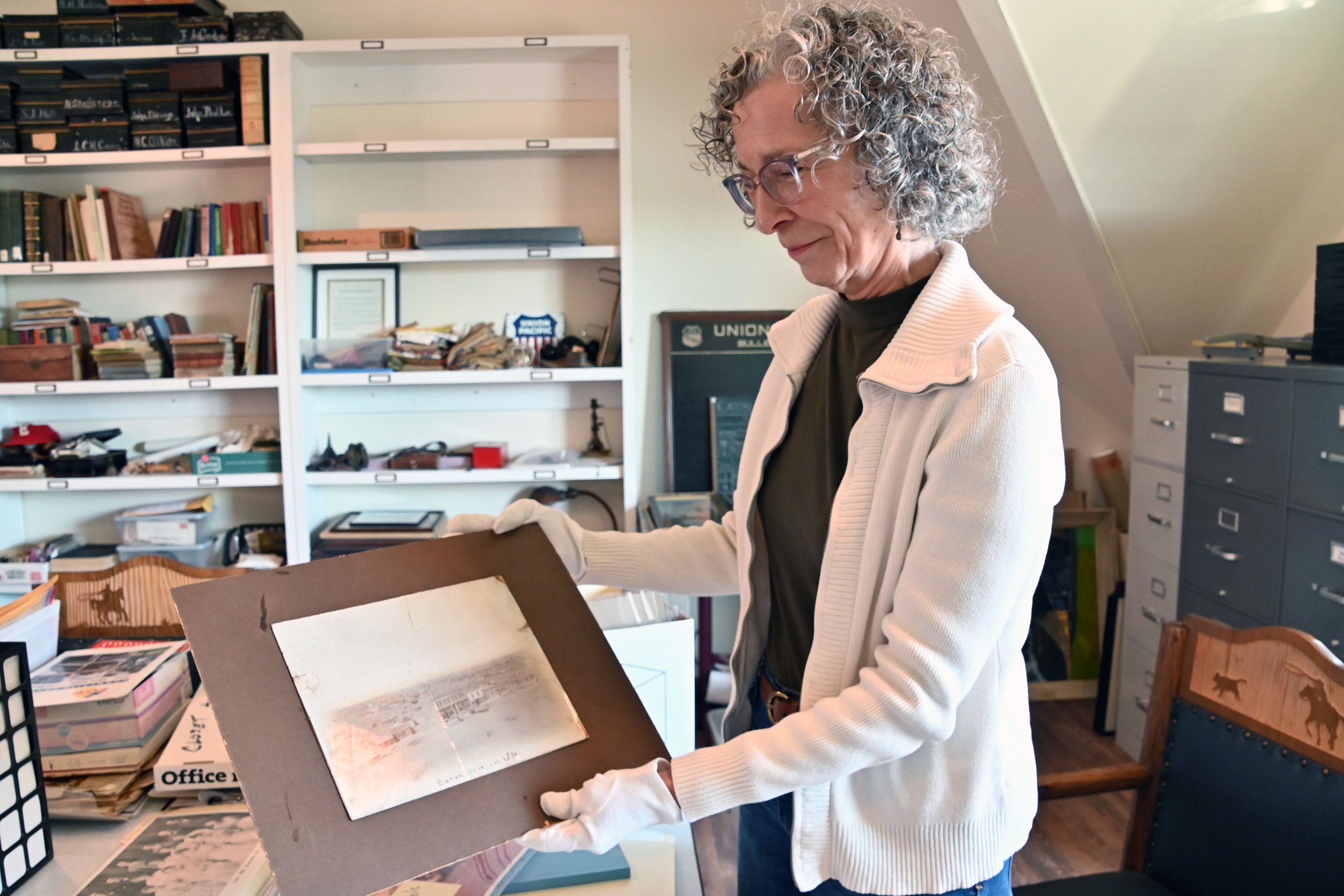
Shan Watkins holds an archival photograph Jan. 31, 2026, of Eaton while sorting documents inside of the Eaton Area Historical Society’s carriage house museum in Eaton, Colo. (Madelyn Fisher)
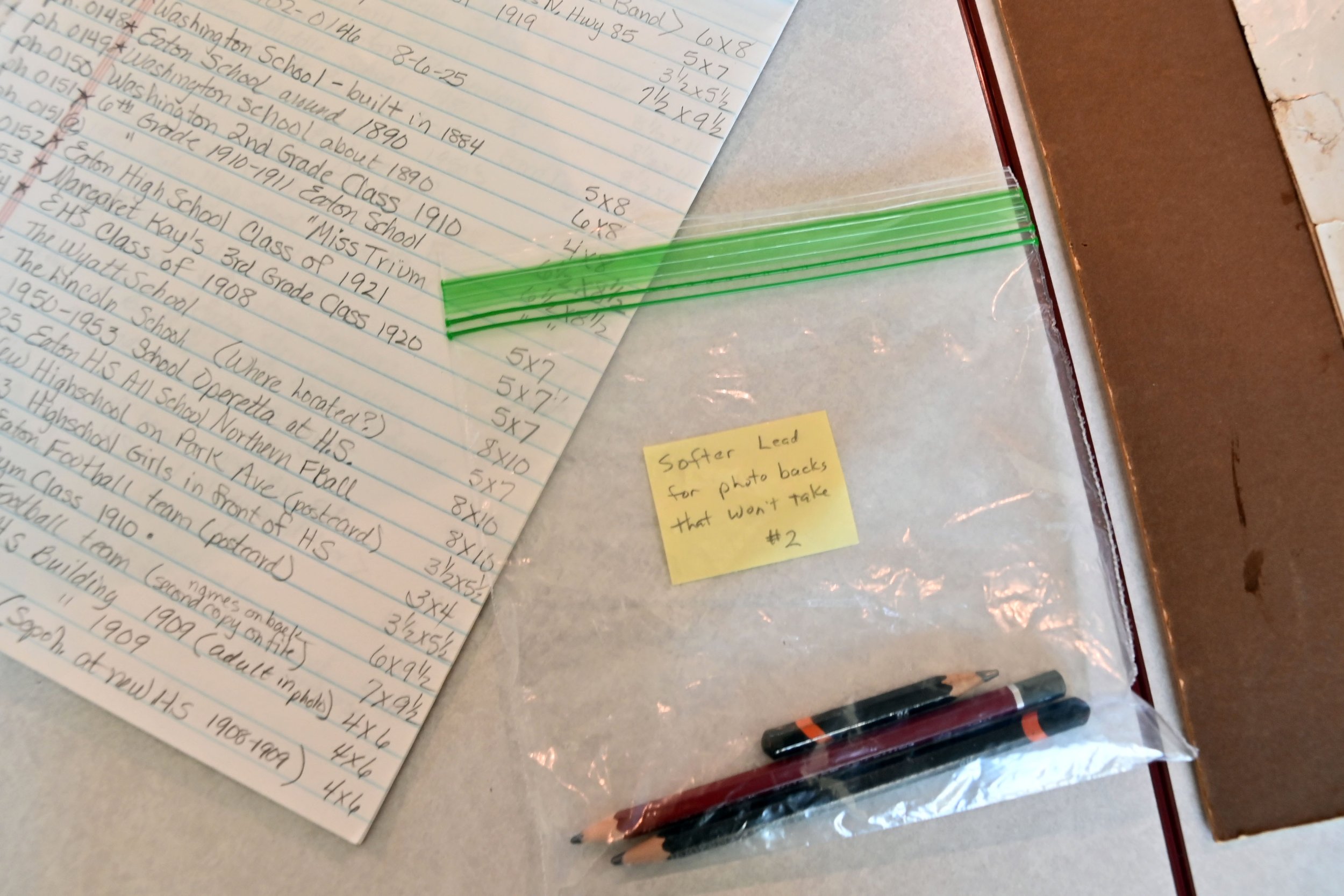
Handwritten inventory notes and soft-lead pencils for the digitizing project sit on a table Jan. 31, 2026, inside the Eaton Area Historical Society’s carriage house museum in Eaton, Colo. (Madelyn Fisher)
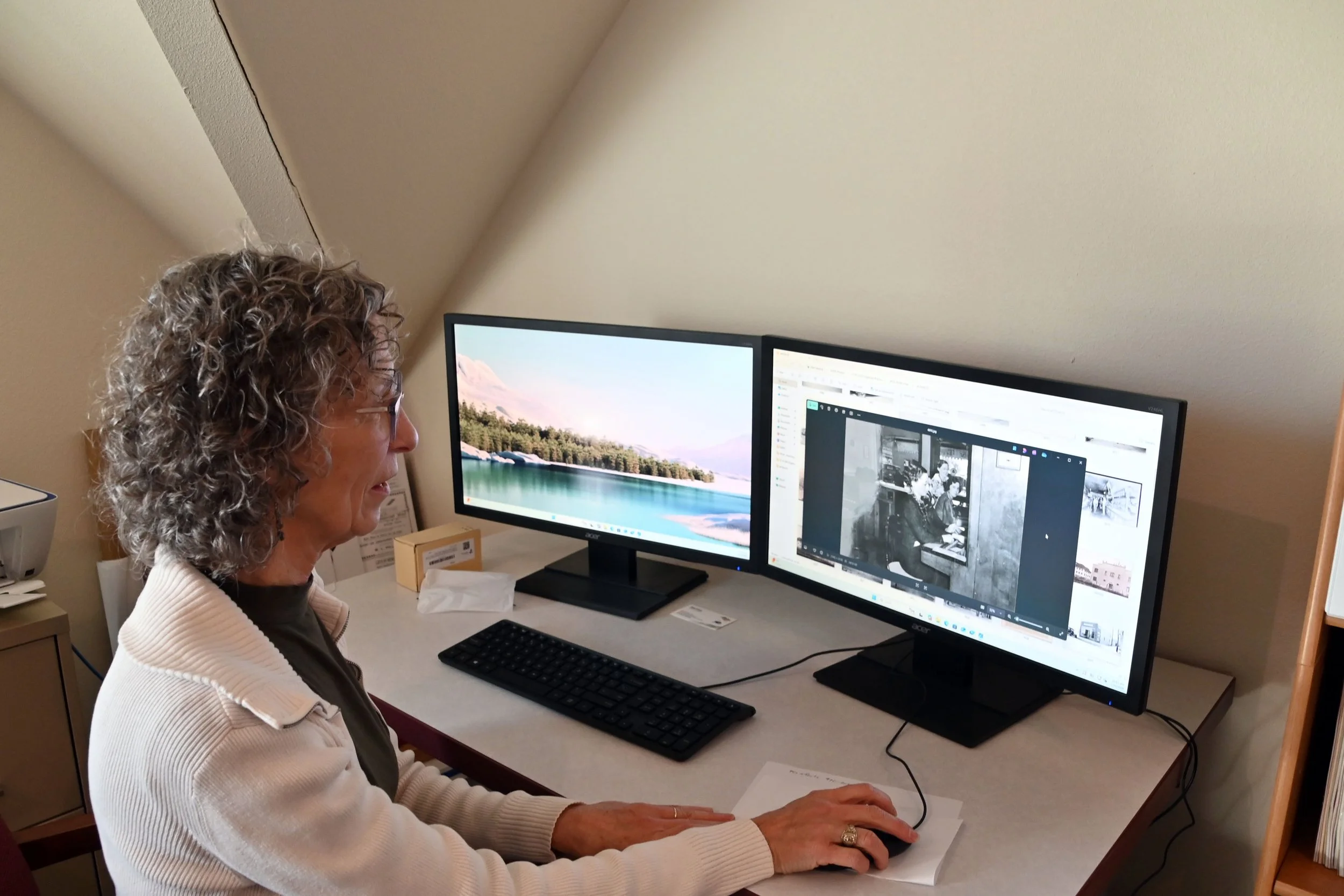
Shan Watkins views newly digitized photographs on Jan. 31, 2026, on a new computer inside the Eaton Area Historical Society’s carriage house museum in Eaton, Colo. (Madelyn Fisher)